
In 1874 a banker in Illinois became the first man in the world who couldn't open his own vault before morning. He slept better than any banker alive.
For forty years, bankers refused the one lock that could have saved them.
It existed. An Englishman had patented a clockwork lock in 1831 that would hold a door shut until a set hour, no matter who stood in front of it. Bankers looked at it and said no. Why would a man lock himself out of his own vault?
Then, in the late 1860s, the robbers found an easier way. Instead of the steel, they went after the man who knew the combination. Under pressure, he gave it to them, because of course he did. Anyone would. The worst of it came in Northampton, Massachusetts, in January 1876, when a gang got every number the cashier knew and walked out with more money than had ever been taken from an American bank.
Bankers changed their minds about time locks very quickly after that.
James Sargent of Rochester had already patented his in 1873, and on 2 May 1874 he fitted the first one himself, to the vault of the First National Bank of Morrison, Illinois. Once set, the door would not open before morning. Not for a robber with the combination. Not for the cashier, whoever was standing behind him. Not for Sargent. It stayed on that door for nearly forty years.
Notice what the lock didn't do. It didn't make the cashier braver or the steel thicker. It made the cashier pointless. There was nothing he could give a criminal that would open the door before nine o'clock, so there was no reason to come to his house.
The safest man in the bank was the one who couldn't help you.
The night stopped needing him. And a man nobody needs at night sleeps.
It's a hundred and fifty years on and the robbers are still going to the man, not the steel. The email, the invoice, the password reset. You'd know if your bank balance moved. You'd know if the ute wouldn't start. There has never been a way to know about this, so you've done what sensible people do with a thing that has no gauge: assumed, and got on with it. That's not carelessness. It's what the tools gave you.
6:24 this morning
Here's what one member woke up to this morning. Look at it before I say anything about it.
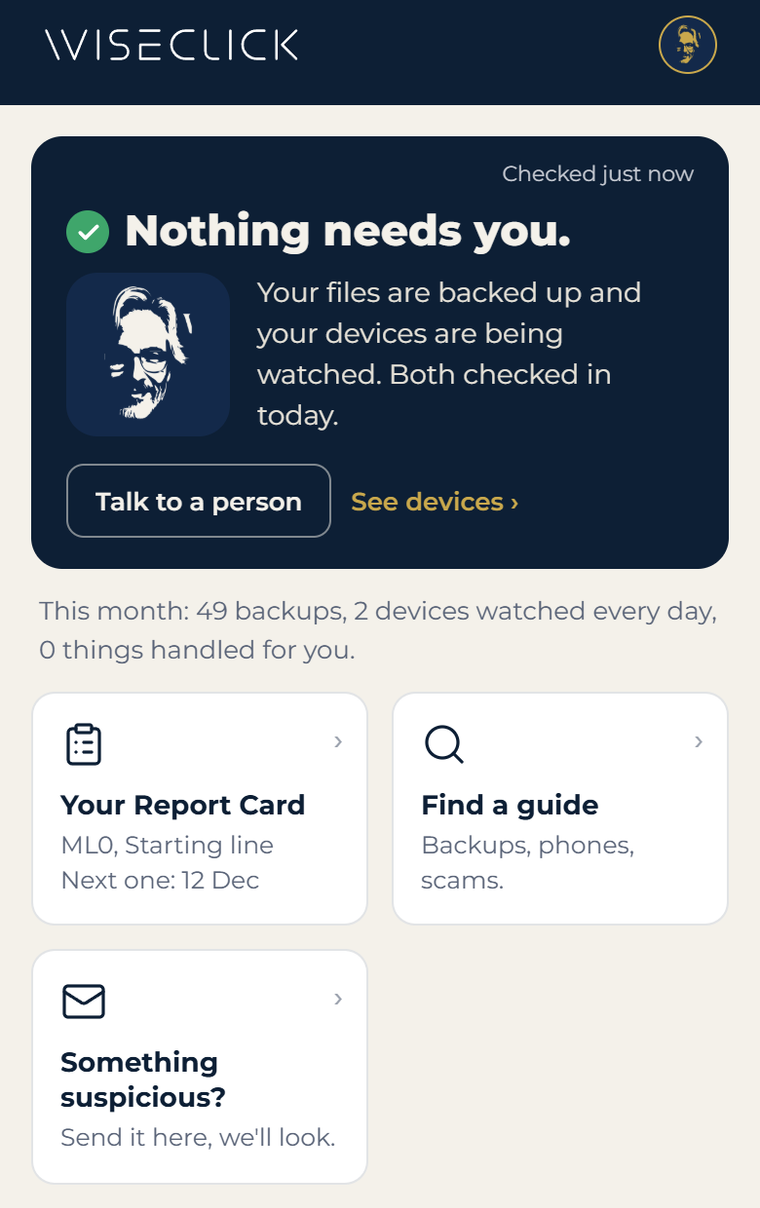
That's the vault opening on time.
At 6:13 a laptop nobody was sitting at woke up and reported in: what had changed since last night, proof it was who it said it was, whether anything needed a look. Everything it handed over was locked the moment it was written: a write-once copy that nothing can change or delete for sixty days, not a stolen password, not malware, not us. The sentry on the machine had nothing to say, and said so. Then the whole night reported in to the owner, in four lines, and one sentence underneath that took a great deal of engineering to earn the right to say.
Nothing needs you. Enjoy it.
There was no second screen to open. That's the design.
You don't have to understand the mechanism. The banker in Morrison didn't understand clockwork either. He came in at nine and the door opened.
The rounds it can't walk
The lock covers the vault. It doesn't cover the man at the door at quarter past two with an invoice, new bank details, and a polite note. Or the text from "the courier". Those don't come to the machine. They come to you.
So there's a card just below the crop.
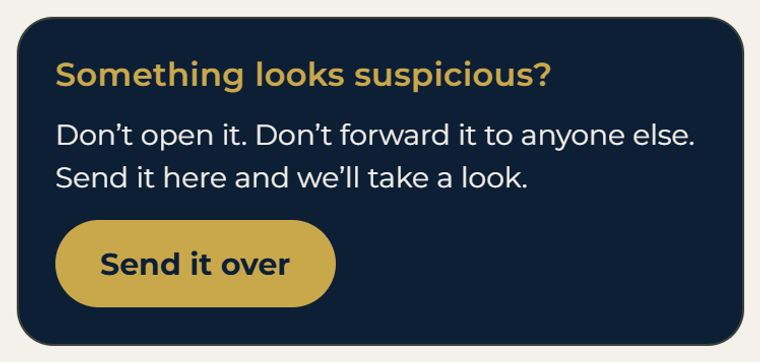
You tap it, attach the thing, write "is this real?", and put the phone face down. A person in Sydney opens it somewhere it can't do any harm, follows it to where it leads, and writes back the same business day. Sometimes the answer is three words.
It's real. Pay it.
You don't have to know. You have to ask. Asking takes a thumb.
And below that sits the thing I've never seen another security product offer. A card called Helpdesk, and it's for everything else. Not "is this a virus". Anything. Should I be paying for this software? My bookkeeper wants into my email, is that normal? What's this renewal form actually asking me? You write it the way you'd say it, a person in Sydney reads it, and you get an answer you can act on, in the same plain English.

Have a question? Ask. I've looked, and nobody else lets you.
That's the whole arrangement, and it has a name. A WISECLICK membership is the locked copy of everything on your machine, the sentry watching it, the screen that reports in each morning, and a person to ask. It's $59 a month for one machine, and you can cancel any time. The door is at wise.click. The app is the newest thing behind it.
The screen is only the first thing the app does. Next comes your own standing, the same plain-English rating we give in the Report Card, on your phone, and guidance written for your trade rather than for a bank. Members see those first.
It's nearly here. If you're a member, it will find you. If you're not yet, the door is above, and the box below is one dispatch a week and first word when the app opens.
What's worrying you?
Someone asked me that last week. The ordinary question you ask a man who runs a business from a laptop, the way you'd ask about his back.
I thought about it properly, because it deserved that.
Nothing.
Not because I'm brave, and not because nothing could go wrong. Because there's nothing anyone can make me do, and in the morning a screen tells me so. That's what Sargent gave the banker in Morrison, and it's what a membership gives you: not a thicker wall, a reason for nobody to come to the house.
Put the phone face down.
Frequently asked questions
If my backup is locked, how do I get my own files back?
Any time you like. The lock stops anyone deleting or altering what's been backed up before its term is up. It never stops you reading it or restoring from it. Sargent's vault was the same: the money was always yours, it just couldn't leave before nine.
Does the app replace Windows Defender and OneDrive?
No, and I'd never tell you to turn either off. Defender does a real job on the machine, and OneDrive does a real job keeping your files synced and within reach. Membership adds what neither is built to do: a copy of everything that can't be changed along with the originals, whoever is holding the keyboard, and a person to read the log in the morning and answer "is this real?" in the afternoon.
What happens when I'm on holiday and the laptop is off?
Nothing bad. A switched-off laptop can't be backed up, but everything already in the vault stays locked for its full sixty days from the last successful backup, and the clock restarts the moment the laptop next reports in. A quiet laptop is a sleeping laptop, not an unprotected one.
Can I send you a suspicious email or file from the app?
Yes. That's the "Something looks suspicious?" card in the app. Attach the thing, tell us what's bothering you about it, and a person looks at it somewhere it can't do any harm and tells you whether it's safe. Members ask. That's the whole arrangement.
I'm a sole trader with one laptop. Is this for me?
It's built for you. One laptop is one line on the screen, and one login is one vault. Sargent's lock was built for exactly that size of bank.
One dispatch a week. Worth the coffee it's read with.
Calm, plain-English cybersecurity for people who run real businesses from a laptop.
Stay protected, my friends.
— The Most Secure Man Alive

Leave a comment
This site is protected by hCaptcha and the hCaptcha Privacy Policy and Terms of Service apply.